

Part 2. The Ultimate Guide to Financial Freedom: Passive Income for Beginners
7 minutes, 19 seconds read:
Hello, Sweet Money Readers,
Welcome Back! This is part two of our special series called 7 Proven Strategies for Building Wealth
Part one discussed a big question: What is financial freedom?
We also shared the first step to reach it: building a strong money foundation.
Missed part one? Click here to read it now.
Today, we’re moving on to the second step in your journey to growing wealth.
Step 2 is all about something exciting: Passive Income.
Let’s get started!
What Is Passive Income? (And Why It Matters for Building Wealth)
Passive income means making money without working all the time.
Once you set it up, it keeps earning money for you even when you’re sleeping or relaxing! That’s different from active income, where you trade your time for money, like at a regular job.
With passive income, you do the hard work upfront, and then the money can keep coming in with little daily effort.
Why Is Passive Income So Powerful?
… Earn While You Rest: You don’t have to work nonstop to earn money.
… Less Risk, More Income: Having more than one way to make money keeps your finances safer.
… More Free Time: Spend your time doing what you love: traveling, hobbies, or being with family.
Pretty cool.
Now, look at some exciting and straightforward passive income ideas you can start today!
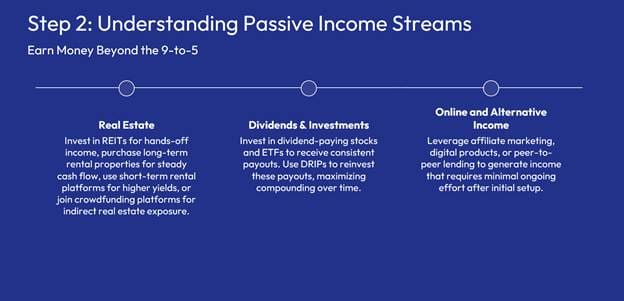
Earn Passive Income with REITs: Real Estate Investing Without Buying Property
- Invest in Real Estate Without Buying a House (REITs)
What Is It?
REITs (Real Estate Investment Trusts) own or manage buildings like apartments, offices, or hospitals.
When you invest in REITs, you earn a share of their profits, which are usually paid to you as dividends.
How to Get Started:
- Open a brokerage account (where you can buy and sell investments, e.g., Fidelity, Vanguard, or Schwab).
- Pick REITs that match your goals and how much risk you’re okay with.
Why It Could Work:
REITs can be a super-easy way to make money from real estate, without buying a house.
You can invest a little or a lot, and since they’re on the stock market, you can buy or sell at any time.
Best of all? You earn passive income while the REIT does the work.
2. Make Money from Rental Properties (Long-Term Leases)
What Is It?
You buy a home, condo, multi-family home or other dwelling and rent it to people for a steady monthly income.
The rent you earn should cover your bills (like the mortgage and repairs), and you keep the extra cash.
How to Get Started:
- … Buy a property.
- … Rent it out to people who stay for a year or more.
- … If you want less work, hire a property manager to help find tenants or make repairs.
Why It Could Work:
Once it’s all set up, rental properties bring in steady monthly money.
Your property might also grow in value over time, which means you can make even more if you sell it later!
Consider my great-grandparents as an example of why real estate ownership and rental property stewardship works.

My great-grandparents, Dinah and William, were adept at scouting real estate investments and turning them into income properties.
They were a wise and brilliant couple.
Altogether, they built a portfolio of several income properties with dozens of tenants.
Some of their tenants included small businesses.
These businesses offered employment to the local community, which helped it thrive and grow.
My great-grandparents were consequential real estate investors.
They combined income and price appreciation through rents and land value to make themselves extremely comfortable in the 1950s.
That’s why I know owning real estate is one of the keys to long-term wealth building.
Now, if you own a property but want to rent out portions of it for income in the short term, consider short-term renting.
3. Short-Term Vacation Rentals (e.g., Airbnb)
What It Is: Renting out your home, a spare room, or investment property on short-term rental platforms like Airbnb or Vrbo allows you to charge a higher daily rate than long-term rentals. You can rent out the space to travelers and vacationers.
How to Get Started:
- Find a space to rent (a room or a whole home).
- Take lovely photos and list them on Airbnb or a similar site.
- You can do the cleaning and messaging yourself or hire a service to help. Use a management service (like Guesty) or handle cleaning and guest communication for a more hands-off approach.
Why It Could Work: This model can yield higher rental income, especially in tourist-heavy areas. You can create a passive income stream from your property with minimal time commitment. Preparing the space may require effort initially, but you can earn money once it is set up. At the same time, you’re away or focused on other projects.
- Real Estate Crowdfunding
What It Is: Real estate crowdfunding platforms like Fundrise, RealtyMogul, or CrowdStreet allow you to pool money with other investors to fund large real estate projects or developments. As a result, you earn a share of the income or profits generated by the project, such as rent or capital gains from property sales.
How to Get Started:
- Sign up on a crowdfunding site like Fundrise, RealtyMogul, or CrowdStreet.
- Pick a project that fits your goals and how much risk you’re okay with.
- Start investing with as little as $500 to $1,000.
Why It Could Work: This is an easy way for beginners to invest in real estate without buying properties. It’s a hands-off way to generate passive income from real estate projects, and you can often earn returns through rental income and project appreciation.
As with any new venture, always conduct due diligence before making any commitments.
How to Make Passive Income with Dividend Stocks
Another source of passive income is dividend stocks and investments.
Dividend investing involves buying stocks or securities that pay out a portion of their profits to shareholders regularly. Investing in companies that pay dividends is one of the best ways to build a passive income stream. Here’s how you can get started:
- Dividend Stocks
What It Is: These are shares of companies that regularly distribute a portion of their earnings to shareholders in the form of dividends. Companies like Coca-Cola, Pepsi, Johnson & Johnson, and Procter & Gamble are known for their reliable dividend payouts.
How to Get Started:
- Open a brokerage account (e.g., Fidelity, Vanguard, or Schwab).
- Research companies with a strong history of paying dividends (known as Dividend Aristocrats, which have consistently raised dividends for 25+ years).
- Invest in dividend-paying stocks and set up a Dividend Reinvestment Plan (DRIP), which automatically reinvests your dividends to buy more shares, compounding your income over time.
Why It Could Work: Dividend stocks provide regular, predictable payouts (quarterly, semi-annually, or annually) without much active involvement. The more shares you hold, the higher your income stream. With DRIP, the potential for long-term growth.
- Dividend ETFs (Exchange-Traded Funds)
What It Is: Dividend ETFs are funds that hold a collection of dividend-paying stocks. They provide exposure to a diversified basket of dividend-paying companies.
Dividend ETFs to Buy TODAY
Consider choosing a dividend-focused ETF, such as the Vanguard Dividend Appreciation ETF (Ticker: VIG), the iShares Select Dividend ETF (Ticker: DVY), or the SPDR S&P Dividend ETF (Ticker: SDY).
- VIG is an ETF that tracks the S&P US Dividend Growers Index. The ETF holds mid and large-cap U.S. stocks. Its investments focus on U.S. common stocks with a history of increasing dividends for ten consecutive years but exclude REITs.
- DVY is an ETF that tracks the price and yield performance of the Dow Jones Select Dividend Index. The ETF predominantly holds mid- and large-cap U.S. stocks, and its investments are selected based on dividend yield.
- SDY is an ETF that replicates the performance of the S&P High Yield Dividend Aristocrats Index. The index measures the performance of the highest dividend-yielding S&P Composite 1500 Index constituents that have followed a managed dividends policy, consistently increasing dividends every year for at least 20 consecutive years.
Purchase shares of the ETF through a brokerage account.
Why It Could Work: ETFs are a low-maintenance way to earn passive income from dividends. They provide diversification and reduce risk while offering exposure to a wide range of dividend-paying companies. Dividends are distributed regularly, making this an excellent choice for passive income.
Online Business Passive Income Streams
The internet has opened countless opportunities for passive income through online businesses. Once set up, many of these income streams can be automated, allowing you to earn money with little daily involvement.
Examples of Passive Income from Online Businesses:
- Affiliate Marketing
What It Is: You promote other companies’ products or services on your blog, YouTube channel, or social media. When someone clicks on your affiliate link and makes a purchase, you earn a commission.
How to Get Started:
- Start a blog, YouTube channel, or social media presence around a niche topic (e.g., tech gadgets, beauty products, or personal finance).
- Consider joining affiliate programs like Amazon Associates or ClickBank.
- Add affiliate links to your content, such as blog posts, YouTube descriptions, or Instagram posts.
Why It Could Work: After creating the content and including affiliate links, you can earn money whenever someone purchases. With the right content and audience, this can become a very passive income stream.
- Create and Sell Digital Products
What It Is: Digital products include eBooks, online courses, stock photos, digital art, or templates. Once created, they can be sold indefinitely without much added work.
How to Get Started:
- Create a digital product (e.g., an eBook, a course, or printable planners).
- Sell your products on Teachable, Etsy, or Amazon Kindle Direct Publishing (KDP) platforms.
- Promote your product through social media or email marketing.
Why It Could Work: You create the product once, which can be sold repeatedly without more effort, creating a steady stream of passive income.
Start Small, Grow Steady: How to Build Passive Income That Lasts
Building passive income streams requires an initial investment of time, effort, or sometimes money.
Still, once the systems are in place, they can generate income with minimal ongoing effort. By starting with just one or two of these ideas today, you can build a diversified income that helps improve your financial security and provides more flexibility.
Whether renting out a room, starting an online business, or investing in stocks, there are doable steps to create a sustainable passive income stream!
That’s it for today.
I’ll cover the Power of Compound Interest in part three of this series!
Until next time, keep investing!
Disclaimer: We will not track any recommendations in Sweet Money Daily. We are just sharing our opinions, not advice. If you want access to the stocks in our model portfolio with tracking, updates, and buy/sell guidance, please check out The GenWealth Report.

